
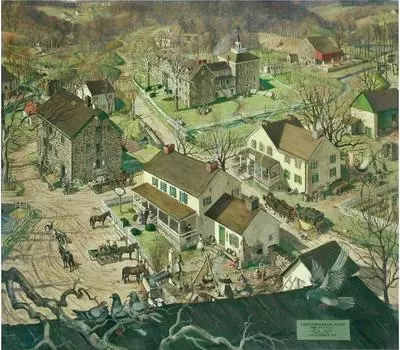
East Pikeland Township is home to Kimberton Village, a quaint village full of rich history. Established in 1817, many of the original structures of the village are still standing and continue to be in use today. If you would like to learn more about the structures and history found in Kimberton Village, you can click here read more.
Tour historic Kimberton Village at your own pace, on your schedule using our new Audio Tour below!
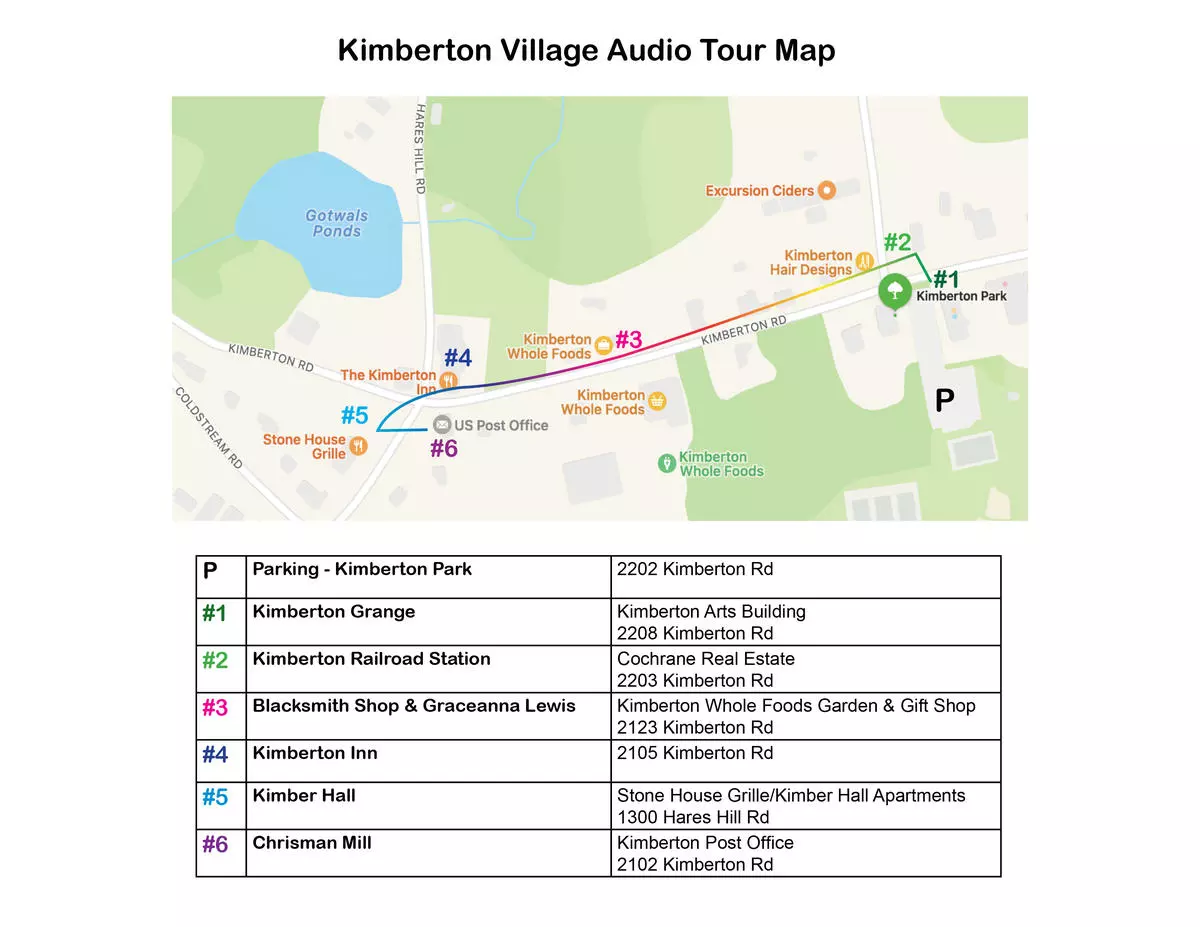

You are standing in front of a building that used to be the Kimberton Grange. It is now the Kimberton Arts building.
The arrival of the Pickering Valley Railroad in the fall of 1871 greatly expanded the area farmers’ access to new markets and shifted the economic activity of Kimberton village from its original 18th century historic crossroad, to its eastern end. The approximately fourteen miles of rail, from Byers to Phoenixville, ran through some of the most productive farmland in northern Chester County. Dairy farmers now came to the milk receiving station on a daily basis. The railroad drew other businesses including Yeager’s general store in 1875 (later known as the Montgomery store- 1918-1945). The railroad had also enticed Dutton Madden, who had purchased a large tract of land from John Rees, and by 1874, had divided it into town lots.
In 1888, the Patriotic Order of the Sons of America purchased two lots across the road from the Kimberton station, and built their Lodge. The Pickering Valley Railroad tracks separated the Lodge from the Yeager’s store.
By 1894, the two lots, including the Sons of America lodge building were sold to William R. Snyder of Snyder, Root & Co. The company operated a window framing factory. A machine shop and foundry also operated in the space and the Kimberton high school used the third floor.
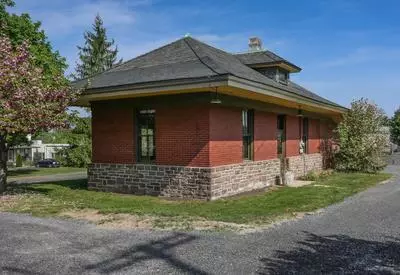
You are standing in front of the Kimberton Railroad Station, a stop on the Pickering Valley Railroad. As you can see it is now home to James A. Cochrane Inc. Real Estate.
As early as the 1830s there was talk of bringing a railroad through the Kimberton area. Finally, on April 3, 1869, the Pickering Valley Railroad Company was incorporated. This spur line was proposed to run through the Pickering Valley from Phoenixville to Byers (Eagle) and would provide a route to move goods (primarily milk and produce from local farms), passengers (particularly students and teachers of the PA State Soldiers’ Orphans School at Yellow Springs), and the mail. The line terminated in Byers.
On September 20, 1871, the first excursion train, comprising 15 passenger cars, 4 freight cars, and several baggage cars, departed Phoenixville. However, after several stops picking up passengers, the weight became too much for the single engine and another engine had to be brought in and hooked to the rear to complete the trip. In early December 1871, the first commercial shipment of iron ore was carried from Byers to Phoenixville.
The Pickering Valley Railroad ran 11.3 miles in length, more or less following the Pickering Creek, with stations at Phoenixville, Main Street, French Creek (Ironsides), Kimberton, Hallman’s, Pikeland, Chester Springs, Cambria (Anselma), Lionville, and Byers. Some stations like Kimberton were attended by ticket agents, others were unattended ‘flag stops’ where a flag was raised if someone needed the train to stop. Sidings were constructed at the Kimberton Station to serve Mr. Yeager’s coaling business (he received deliveries of coal 12-25 tons at a time), and a feed warehouse. Horse and cattle were regularly shipped to Kimberton for auctions held at the Kimberton Inn and Hotel.
On October 4, 1877, a fatal train wreck occurred about 1 mile east of Kimberton, known as the “Pennypacker Tragedy”. It was Chester County’s worst railroad disaster. Most of the passengers on the train were members of the Pennypacker family, returning from a reunion. That day, a torrential rainstorm caused the fill under the tracks to wash away, leaving the ties and rails suspended in mid-air. About 2 inches of rain fell between 5-6 pm, and 4.92 inches had fallen in total.
Around 7 pm, the engineer failed to see the washout ahead, due to the darkness and heavy rain. The engine plunged down a ravine, falling about 50’. Of the 123 people on board the train, 9 died and 85 passengers were injured. After the accident, repairs were made and the railroad continued to operate until after World War I. As the nation’s highway system improved, it became more economical to move materials and finished goods by truck.
In 1934, passenger service was discontinued and in 1948, regular freight service halted. Into the l960s, some freight continued to be moved, particularly bulk items like coal, fertilizer, and occasionally livestock, mostly hogs destined for Roberts’ Meat Packing Co. In 1968, several local businessmen formed the Valley Forge Scenic Railway and ran tourist-oriented excursions from Ironsides to Kimberton. Initially popular, the venture only lasted a few years. Shortly after it ended, the remaining tracks were taken up and the line abandoned.
In Kimberton Village, the station and several other railroad buildings were originally constructed in 1871 as frame structures including a milk receiving station, a portion of which was used as an ice house to cool the milk before shipment to Phoenixville and Philadelphia. The Kimberton Station was one of several along the branch which burnt in 1918. The brick station here today was constructed in 1919. Over the years since the railroad left, it has undergone renovation and housed different businesses.

You are standing in front of a historical marker commemorating the 19th-century naturalist, abolitionist, and social reformer Graceanna Lewis. The marker is located beside Kimberton Village’s original blacksmith shop, a structure that played a significant role in the life of the village.
Graceanna Lewis was a 19th-century American female scientist and was recognized as a leading female naturalist of her day. She dedicated her life to the study of botany and zoology. In 1870 she was one of the first women elected to the Academy of Natural Sciences in Philadelphia. A Quaker abolitionist, she was also active in Underground Railroad activities at Sunnyside Farm, her family’s home near Kimberton. She also actively supported the temperance and women’s suffrage movements.
Lewis was born in 1821 to a Pennsylvania Quaker family and attended the French Creek Boarding School for Girls, which had been established by Emmor Kimber in 1818 and existed for 30 years. Just up the street from the blacksmith’s shop, at the intersection of Kimberton and Hares Hill Roads, the former school’s surviving wing is now known as Kimber Hall, while a 1950s addition is home to the Stone House Grille. The school was a progressive Quaker institution that taught girls botany, astronomy, and chemistry, in addition to the classics, geography, history, literature, and art, at a time when educating young women was not the norm.
The Lewis family believed in the equality of all humans. Sunnyside Farm was a crucial hub in a network of local families on the Underground Railroad. Fugitive marriages took place, disguises were distributed, and elaborate plans were laid and enacted to ensure that families could safely disperse and reunite in the North
Graceanna Lewis promoted the study of natural history throughout her life. She gained acclaim as a naturalist illustrator of wildflowers, trees, birds, and fishes. Her published charts and illustrated booklets explained her theories on the relationships between birds and other species. Her works were shown at the 1876 Philadelphia Centennial Exposition and at the 1904 World’s Fair in St. Louis. In 1893 she was commissioned by the Pennsylvania Forestry Commission to paint a set of 50 watercolor illustrations of representative tree leaves for display at the World's Columbian Exposition in Chicago.
Graceanna Lewis died in 1912.
Blacksmith Shop. The blacksmith shop was a vital adjunct to Kimberton’s surrounding agrarian economy and to the nearby mills. The Pikeland Historical Society has 19th-century photos of at least two other blacksmith shops that existed nearby, one near the corner of Hallman’s store in Chester Springs, and another at Wilson’s Corner, on Pughtown Road.
A blacksmith’s shop in colonial and post-Revolutionary America was very much a part of the bustle of village life. Everyone knew the blacksmith, and vice versa—so news circulated in and out of the shop continually. Plus, blacksmiths worked long days, hammering, or forging, red-hot iron into usable tools—you can imagine the ringing sound of the anvil as a kind of comforting constant in community life. In winter, villagers and children would stop in to warm themselves by the blacksmith’s forge and to watch the smithy work.
Since the decline of the blacksmiths’ trade (probably by 1900), this shop has served at different times as a residence, a firehouse, car repair shop, fly fishing shop, flower shop, and today as the Kimberton Whole Foods Garden and Gift Shop. This small, but important, piece of Kimberton Village thus continues, in its own way, to ring out its story.

You are standing in front of the Kimberton Inn, at the historic crossroads of Kimberton.
The Kimberton Inn has been a contributing resource to the Kimberton Historic District which is on the National Register of historic places. From the beginning this intersection was the village’s agricultural exchange center and stage coach stop. The Kimberton Inn has evolved and has adapted to the changing economies of the village, and has always been a strong business enterprise in the community.
It all began in the 1790’s when George Chrisman started his mill operations. He was taxed on a “still house” or distillery which is said to be the origins of this building in some references however it is possible that it was only a tenant building as is stated on the National Register nomination documents (1986, E Cremer)
Our namesake and one of our village’s prominent predecessors, Emmor Kimber converted this building into the Boarding School Inn in 1820 to accommodate parents and relatives of the scholars attending his Quaker School across the street. It was a stage coach stop bringing families and visitors from Philadelphia to westward stops.
In the 1840’s, the name became the Boarding School Temperance Inn when John Thomas was the proprietor.
Through the 1850’s, Henry Yeager, Jr. was another proprietor as was John Rhoades. In around 1856, the Kimberton Inn was called the Kimberton Hotel.
After the railroad came to the village in 1871, the Kimberton Hotel adapted to the new economic climate becoming the site of public cattle auctions and swap sales in the courtyard between its barn and carriage houses. The courtyard was the scene of minstrel shows, circus shows, accommodated traveling tailors who set up rooms for fittings and for salesmen to sell their wares as well as a general meeting place for the residents of the village.
In 1884 there was a newspaper reference to “the citizens of Kimberton building a stone walkway from Eli Huzzard’s hotel to the railroad station to replace the old wooden one”. In 1901, Eli Huzzard’s wife Rebecca sold the Kimberton Hotel to Isaac Newton Davis.
The year 1909 found the Kimberton Hotel in the middle of an intense court battle between the “wets “and the “drys”. The “drys” won out as noted in the headline “No liquor at the Kimberton Hotel”. This led to much hostility between residents.
The proprietor in 1913 was Joshua Rhoades. He established a market here for the sale of horses and cows.
There is a gap in the records between 1913 and 1933. Then a newspaper clipping from June 24, 1933 announced the “Reopening of the old Kimberton Hotel after being closed for years”.
The Slobodzians, Leon and Frances became the proprietors during the 1940-50’s. They enlarged the dining room and changed the name to “The Kimberton Tavern”. It was advertised as a restaurant and an entertainment center with music and dancing.
The Kimberton Tavern became the “Kimberton Inn and Country House” in the 1960’s and 1970’s with a gift shop and a brochure advertising it as a delightful, charming destination with good food and drink. The first addition during this time included the middle section and the main entrance. A second addition included windows with a bow front.
The name was again changed in 1980 to its current name, The Kimberton Inn”. The current owner, Jeff Effgen bought it in 1991. Under his stewardship, the Kimberton Inn continues to be an excellent dining destination in our area and a treasured relic of Kimberton’s past.

You are standing in front of a building that used to be Kimber Hall, a school and a stop on the Underground Railroad. It is now the Stone House Grille and the Kimber Hall Apartments.
1817, Emmor Kimber purchased 265 acres of hilly land and crossroads with two houses, a store, a flour mill and a saw mill for $36,000. Kimber was a native of Chester County and had been a teacher at the Westtown Boarding School, a recognized Quaker preacher, author of a well-used school primer on arithmetic, and a Philadelphia bookseller. He wanted to start a boarding school of his own, based on his philosophy of firm and gentle persuasion, of gender and racial equality, rational scientific and historical study and the development of the arts.
This building was one of the original houses. The corner stones of the house can be seen on the front with the two side wings that made it the 80 foot façade you see today. A two-story portico with tall pillars was built in the center of the front and a utility wing on the southern side. Construction created a large debt and some difficulties but with the help of friends such as Isaac Wayne, son of the famous Revolutionary War General Anthony Wayne, these were resolved by 1827, whereby Kimber built another large wing off the rear for extra classroom and dormitory space. This wing was unfortunately torn down in the late 1930’s and the stones were used to build some of the new houses on the surrounding land.
Kimber picked this spot because he had long known some of the members of the local Pikeland Meeting, a rural congregation devoted to liberal religious beliefs and active participation in the underground railroad. Kimber built a new meeting house across the street from the school and most of the members joined him there. The progressive philosophy attracted students from Philadelphia, the suburbs and the other coastal states. Later In 1879, Martha Kimber deeded the meeting house to Centennial Lutheran Church of Kimberton.
Kimber was closely connected to the network of safe houses known as the Underground Railroad, especially to the William Still and other black abolitionists of the city, and to the progressive rural Quakers such as the Lewis, Vickers and Fussell families of northern and southern Chester County. His daughter Gertrude married Charles Burleigh, a famous abolitionist preacher and lecturer. These networks secretly directed the refugees from their lives of slavery in Maryland, Delaware and Virginia to the Boarding School, where they were given new clothing or temporary employment or passage on toward a safer home in Canada. In one case a former owner had heard that his “servant” was living with Kimber and asked that he be sent back home so that he could be given his freedom. Kimber wrote a long letter back which outlined the wrongness of slavery, saying that the man had gone on to Canada and that he, Kimber, would not in any case advise the man to go back into slavery. Lucretia Mott, of Philadelphia came to lecture at the school and Kimber’s daughter Abby, a beloved teacher at the school, later went with Mott to an Abolitionist meeting in England, where the two women were famously refused their request to speak.
Years later, many of the former students wrote glowing recollections of their happy years at the school, including Graceanne Lewis, who became one of the first American woman scientists. They recalled the gentle management of the students by Kimber, his wife and daughter and the other teachers, by which reading arithmetic, history and science was combined with exercise of penmanship, composition, drawing, painting and music. The girls remembered fondly the hours of free time at the mill pond and the surrounding hillside pastures. An old ship’s bell rang out to call them back to meals and bedtimes. Kimber seemed to have been successful in building a place for progressive education at a time when such was rare. In many ways the Kimberton Boarding School was a fitting but long forgotten predecessor to the present day Kimberton Waldorf School that succeeded it almost a hundred years later.
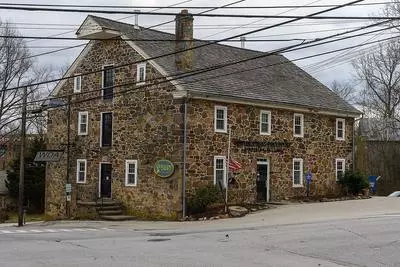
You are standing in front of the Kimberton Post Office, which used to be the Chrisman Mill. It is one of the four historic buildings at the crossroads of Kimberton and Hares Hill Roads.
The Chrisman Mill was named after George Chrisman. He built the grist mill in 1796. In case you didn’t know, a grist mill is where grains are ground. Early settlers used the word “grist” to mean cereal grains. The mill was built near the Royal Springs Creek, to power the water wheel used to grind the grain. Chrisman Mill was well located near the tavern, inn and blacksmith shop. Its location enabled clients to take care of errands while the grain was being milled.
Diagonally across the street from where you are standing, is the Sign of the Bear Tavern. It was operated by Chrisman from 1746 or earlier. After many years he formally applied for a tavern license in 1768. The tavern was also a stage coach stop. Later it was converted to a General store and Post office.
Chrisman’s land holding grew to about 297 acres. They included the farmhouse that became the school in 1787, a still house that was later expanded as the Boarding School Inn and the grist mill. He also operated a saw mill, a limestone quarry and a kiln on his lands.
Chrisman died in 1812. His executors, sons John and Jacob sold his 297 acres to John Snyder. Snyder kept 30 acres including the Tavern, selling the remainder in 1815 to Enoch Walker and Thomas George, who in turn sold to Emmor Kimber in 1817.
Kimber operated the Mill through a manager. He sold the mill with 17 acres of land to John Thomas in 1830. Subsequent owners and operators of the mill were Samuel Bertolet (1858-1881), David Gable (1881-1905), and Sylvester H. Pennypacker (1905-1943). Grinding was stopped in 1938. It operated as a feed store in 1939 and 1940, and closed completely in 1943.